
Isolation
Each organization’s workloads are scoped and isolated. Members only see resources their organization owns.
Ownkube is built so your code and data stay protected however you run. On Ownkube-hosted compute, your apps run in isolated, encrypted infrastructure Ownkube operates, with per-organization scoping. When you run in your own AWS account, your code, data, and runtime stay inside your VPC, and the Ownkube control plane only ever receives configuration intent.
Isolation
Each organization’s workloads are scoped and isolated. Members only see resources their organization owns.
Encryption everywhere
Data is encrypted at rest and in transit with TLS on every hop.
Secrets protected
Secret env vars are encrypted at rest and masked everywhere in the UI, decrypted only into the runtime secret store.
No lock-in
Standard containers on standard Kubernetes. Move the same app to your own cloud with no rewrite.
When you connect your own AWS account, Ownkube is designed so your code, data, and runtime stay inside it. The control plane in our cloud only receives configuration intent. The actual workloads, databases, logs, and traffic all live with you.
Least-privilege IAM
A single scoped-down IAM role in your account. No access keys stored, no root credentials ever used.
No data egress
Application traffic, request bodies, database rows, and logs never leave your VPC.
Encryption everywhere
At rest with AWS KMS keys in your account. In transit with TLS on every hop.
Disconnect anytime
Remove the IAM role and your cluster keeps running. You own the VPC, the nodes, and the data.
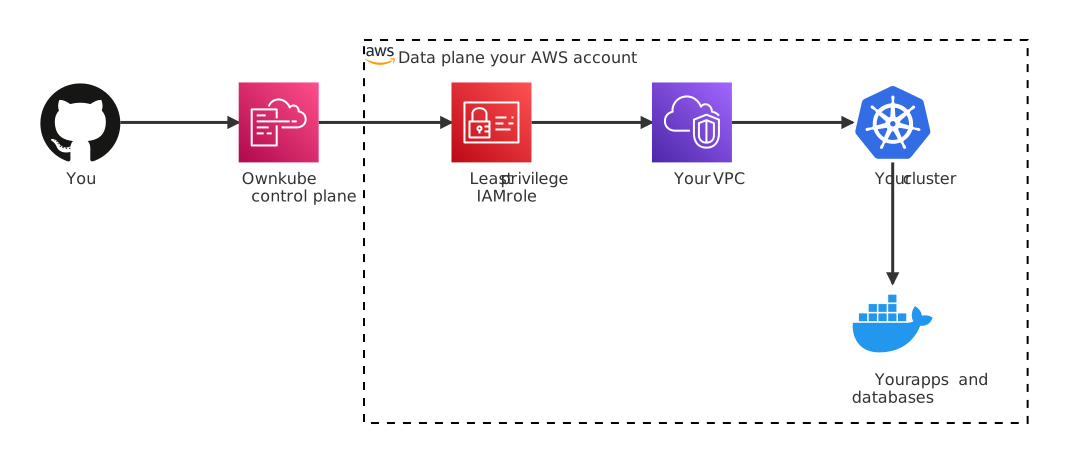
When you connect your AWS account, a CloudFormation stack creates a single IAM role with:
No long-lived AWS credentials are stored in Ownkube’s database. Every action uses short-lived STS credentials obtained by assuming the role with the external ID.
| Data type | Where it lives | What Ownkube sees |
|---|---|---|
| Application code | Your container registry | Nothing (Ownkube pulls it to your cluster) |
| Application traffic | Your cluster’s load balancer | Nothing |
| Request bodies, responses | Your cluster | Nothing |
| Database rows | Inside your cluster | Nothing |
| Environment variables | Your cluster’s secret store, encrypted at rest | Encrypted reference only |
| Container logs | Inside your cluster | Nothing |
| Deployment config | Ownkube database (encrypted) | Yes: image, env var keys (values encrypted), scale, probes |
Environment variable values marked as Secret are encrypted at rest in Ownkube’s database and masked everywhere in the UI. They’re decrypted only when being pushed into the cluster’s secret store, which itself is encrypted at rest with AWS KMS.
Because everything runtime lives in your AWS account, your compliance scope mirrors whatever you already have with AWS.
Ownkube itself maintains standard operational controls for the control plane. If you need documentation for your own audits, reach out.
Ownkube provisions standard AWS resources inside your VPC: EC2 instances, EKS clusters, Elastic Load Balancing, S3 buckets for state, ACM certificates, DNS records. No proprietary APIs, no custom runtimes.
If you disconnect Ownkube, all of those resources are standard AWS things you can continue to manage directly.
Remove the IAM role (or delete the CloudFormation stack) and Ownkube loses access. Nothing gets torn down. Your clusters keep running, your databases keep serving traffic, your TLS keeps renewing. AWS handles all of that. Reconnecting is a three-minute flow.
Email + OAuth (GitHub, Google) for users. Sessions are short-lived. Organization-scoped access: members only see resources their organization owns.
API keys are revocable from Settings and never printed in logs. A public API and CLI are on the roadmap.
Key actions (clusters created, deployments changed, registries connected) are logged with user, timestamp, and organization. Surfaced in the dashboard progressively. Full audit export is on the roadmap.
Responsible disclosure welcome at support@ownkube.io. We triage within one business day.