

On this page 9 sections
The best Railway alternatives in 2026 are Ownkube, Render, Fly.io, Northflank, DigitalOcean App Platform and Coolify.
Ownkube is the closest swap if your worry is the bill: you load a prepaid wallet, apps draw it down per minute, and credit you do not spend rolls over. Render suits steady services with fixed prices, Fly.io suits apps spread across continents, and Coolify suits people happy to run their own server.
Railway is still one of the nicest ways to ship a container, so this post also covers when to stay.
Our picks
| If you want | Pick |
|---|---|
| A bounded bill and a full stack (Postgres from $4, a cache from $2) | Ownkube |
| A few steady, busy services at flat prices | Render |
| Low latency for users on several continents | Fly.io |
| Kubernetes power without running Kubernetes | Northflank |
| To run the server yourself | Coolify |
| To stay next to your existing DigitalOcean resources | DigitalOcean App Platform |
The Railway alternatives at a glance
Prices are approximate list prices from each provider’s pricing page, as of October 2026. They move, so read the table as the shape of each model.
| Alternative | Billing model | Smallest service | Managed Postgres | Best for |
|---|---|---|---|---|
| Ownkube | Prepaid wallet, metered per minute or a flat box per app | Metered from cents, or a Spark 1 box at $5 a month | Yes, from $4 a month | Personal software and small teams who want a bounded bill |
| Render | Workspace plan plus flat instances, postpaid | $7 a month (0.5 CPU, 512 MB) | Yes, from $6 a month | Steady services with predictable line items |
| Fly.io | Per-second machines, postpaid | $2.19 a month (shared-cpu-1x, 256 MB) | Yes, managed from $38 a month | Global, multi-region apps |
| Northflank | Per-second compute, postpaid | $2.70 a month (0.1 shared vCPU, 256 MB) | Yes | Teams that want Kubernetes power without running it |
| DigitalOcean App Platform | Flat container tiers, postpaid | $5 a month | Yes, from $15.15 a month | Teams already on DigitalOcean |
| Coolify | Free software, you pay for the server | Whatever your server costs | You run it | Developers happy to operate the box |
Render, Fly.io, Northflank and DigitalOcean keep Railway’s postpaid model and change the pricing shape. Coolify moves the platform onto a server you run. Ownkube changes the billing direction: you load a wallet first and usage draws it down.
For Render and Northflank in more depth, see Railway vs Render vs Northflank.
Why people look for a Railway alternative
The reasons tend to show up on the invoice or in the roadmap rather than in the first demo.
The postpaid surprise bill
Railway meters usage by the second and bills it after the fact. That works when someone watches the dashboard daily. It bites when a test service runs all month, or a traffic spike meters against a card faster than an alert reaches you.
Credit that resets each month
Railway’s plans include a monthly usage allowance scoped to the cycle. A quiet month does not bank credit you can spend later.
The old free plan is gone
What remains is about $1 of credit a month after a one-time trial credit. For a lot of side projects, the free plan was the reason to be there.
The roadmap is moving upmarket
Like most of the category, Railway is building for Pro and Enterprise buyers. That is a healthy move for the company, and it puts the one-developer project further from the center of the roadmap.
The alternatives, one by one
Ownkube
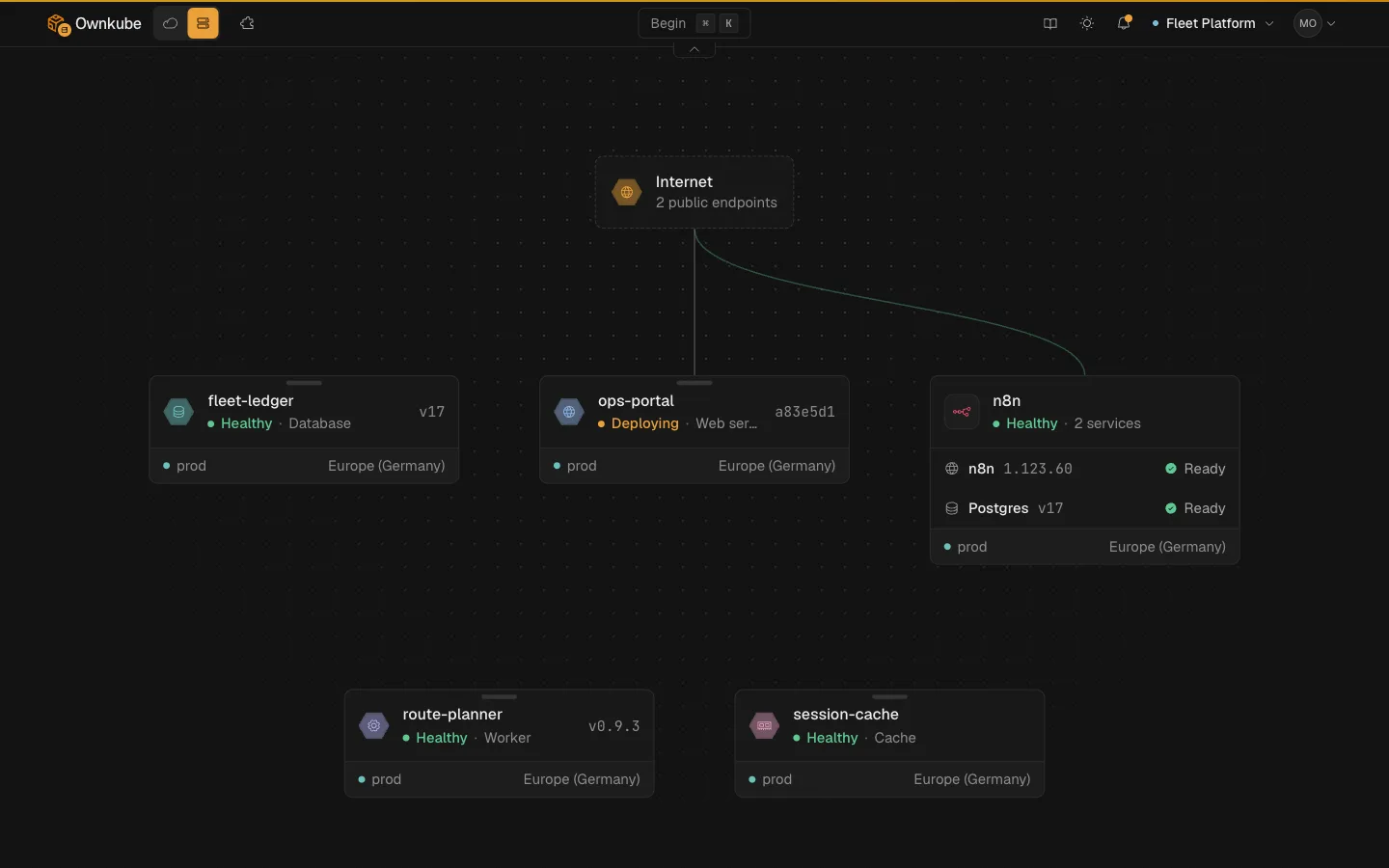
Ownkube is a cloud for personal software. You deploy web apps, workers, cron jobs, Postgres and a Valkey cache onto Ownkube Compute with no cloud account to set up. Connect a GitHub or GitLab repo (a Dockerfile is optional) or pick an app from the Marketplace, and it gets an *.ownkube.app hostname with TLS.
Billing is a prepaid wallet. Pay as you go starts with a $5 top-up. Personal ($5 a month) and Team ($20 a month) load that much credit each month and raise the limits. Usage draws the wallet down per minute, and unused credit rolls over and never expires.
Each app either meters CPU and memory on actual use (about $18 per vCPU and $4.50 per GiB a month) or sits on a flat box (Spark from $5, Core from $58). Databases run on boxes from $4 a month plus $0.25 per GB of storage, and caches start at $2. For the full-stack math, we priced a web app, Postgres and a cache on seven platforms.
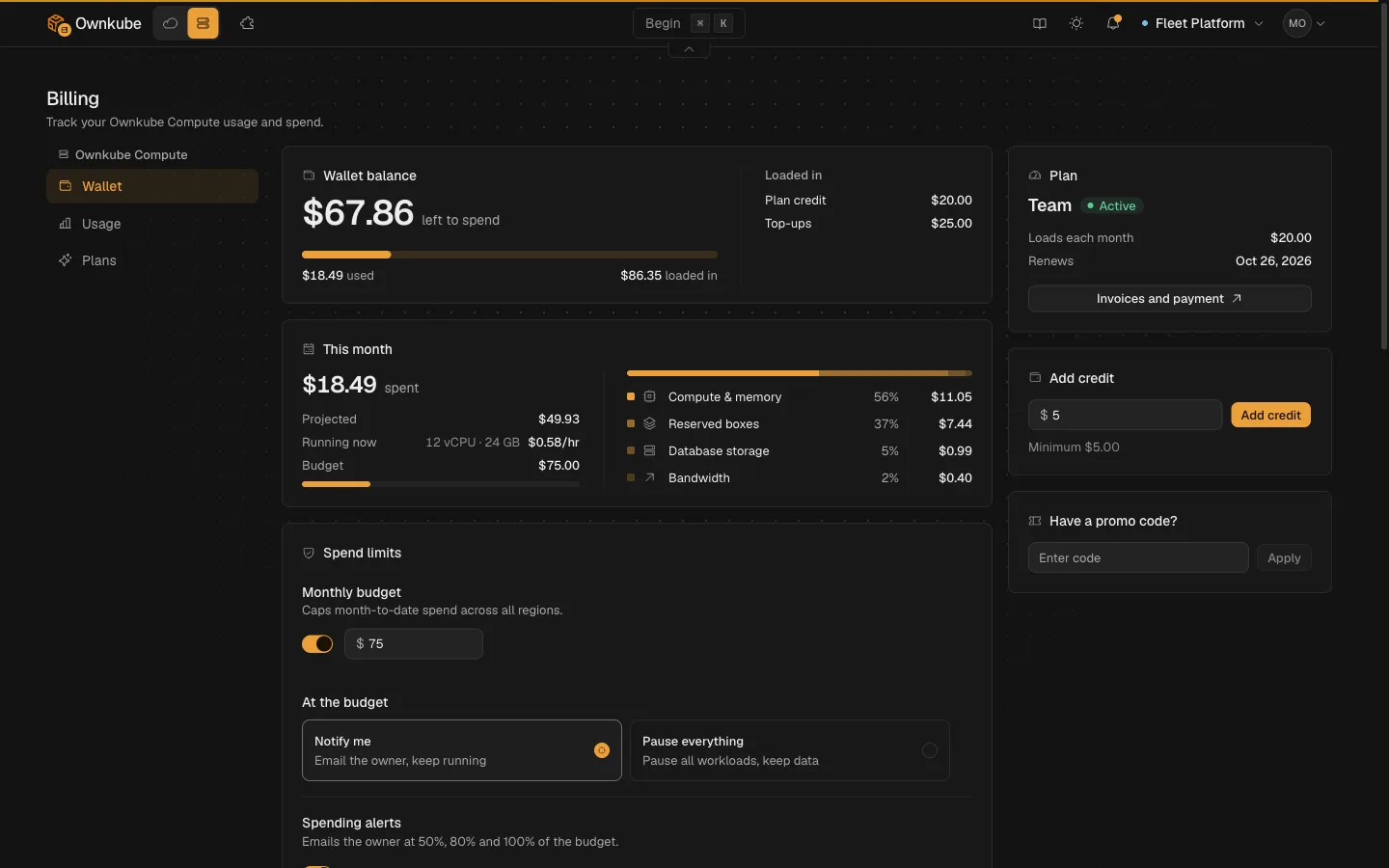
Idle web apps, databases and caches can sleep. A sleeping app meters nothing, a sleeping database bills only its storage, and the next request wakes it. You can also set a monthly budget that either emails you or pauses everything.
The trade-offs: two regions today (Mumbai and Germany), no GPU, and custom domains are not on Ownkube Compute yet, so apps use their *.ownkube.app hostname.
When an app later has to run inside your own or a customer’s AWS account, the same app ships there with no rewrite, and its logs, metrics and health checks come with it.
Render
Render bills a workspace plan (from $0, Pro at $25 a month) plus a flat price per instance. A 1 CPU, 2 GB service is $25 a month whether it idles or not. That is easy to forecast, and expensive for apps that mostly idle.
Its free instances spin down after 15 minutes idle, and free Postgres expires after 30 days. See Render pricing explained.
Fly.io
Fly.io runs Machines in many regions and bills them per second while they run. It is the strongest pick when latency on several continents matters. Managed Postgres starts around $38 a month, which changes the math for small apps. See Fly.io pricing explained.
Northflank
Northflank bills compute per second and offers GPU, job runners and an option for platform teams to run it in their own cloud. It feels closer to a Kubernetes control panel than a quick-start platform, and teams that want that power pick it for exactly that reason.
DigitalOcean App Platform
App Platform has flat container tiers from $5 a month and managed databases from about $15. It fits best when your Droplets, Spaces and databases already live on DigitalOcean.
Coolify
Coolify is free, open-source software that turns a server you rent into a small platform. You pay only for the server. You also patch it, back it up and debug it at 2am. See the self-hosted PaaS comparison.
Railway vs Ownkube
| Ownkube | Railway | |
|---|---|---|
| Pricing structure | Metered, or a flat box, chosen per app | Metered usage, per second |
| Billing method | Prepaid wallet the plan loads and usage drains | Plan credit, then postpaid to your card |
| Credit rollover | Unused wallet credit rolls over and never expires | Monthly allowance resets each cycle |
| Entry plan | Pay as you go from a $5 top-up; Personal $5 a month | $5 plan with $5 of usage |
| Managed Postgres | Database box from $4 a month plus $0.25 per GB | Metered like any other service |
| Idle apps | Sleep and meter nothing; databases bill only storage | Optional sleep for serverless services |
| At zero balance | Apps pause with data kept, resume on top-up, deleted after 7 days paused | Billing continues on the card |
| Custom domains | Not on Compute yet | Yes |
| GPU | No | Yes |
Railway figures are approximate, as of October 2026.
When to stay on Railway
Stay if developer experience is what you value most. Railway’s onboarding, templates and project graph are among the best in the category, and Ownkube’s dashboard is younger.
Stay if you need GPU workloads or a custom domain on every app today. And stay if your bill is steady and someone already watches it.
A quick checklist before you switch
- Price the whole app (web, worker, Postgres, cache, egress), not the web process alone.
- Check where your users are and whether two regions cover them.
- List the domains you serve today and whether an
*.ownkube.apphostname works for now. - Export the database with
pg_dumpand test a restore before you cut over. - Decide whether you want a hard ceiling on spend or an alert.
FAQ
Is there a Railway free tier?
Railway’s free plan is about $1 of credit a month after a one-time trial credit. Ownkube Compute has no free tier: Pay as you go starts with a $5 top-up, and that credit never expires.
Does Railway credit expire?
Railway’s plan credit is scoped to the billing cycle and resets. Ownkube’s wallet credit rolls over to the next month and never expires. More in does Railway credit roll over or expire.
Railway vs Ownkube cost: which is cheaper?
On compute alone the two are close. Railway’s per-second CPU lands near Ownkube’s metered CPU, and Ownkube’s memory rate is lower.
The gap opens with the database and cache. A 1 vCPU / 1 GiB web app, a 1 GiB / 10 GB Postgres and a small cache land around $44 to $56 a month on Railway, against roughly $27 on Ownkube. Those figures are approximate, as of October 2026. Run your own sizes on the homepage calculator.
Can I move from Railway without a Dockerfile?
Yes. Ownkube builds straight from a GitHub or GitLab repo with automatic build, and uses your Dockerfile when there is one.
For the side-by-side breakdown, see Ownkube vs Railway in the docs.
Where Ownkube fits
Move off Railway when the postpaid meter or the monthly reset is what costs you. Stay if polished onboarding, GPU or custom domains matter most today.
Ownkube is built for personal software and small teams. You ship in seconds, load a wallet instead of exposing a card, and keep the credit you do not spend. Deploy my first app.