
 Abhishek Jaiswal
Railway and Render solve the same problem, running your web apps, workers and databases without a cloud account to manage, and they price it in opposite ways. Railway meters the CPU and memory each service actually uses. Render sells fixed instance sizes at a flat monthly rate. That one difference decides which is cheaper for your app, so this post starts there, then covers databases, free tiers and features. All prices are list prices checked on 2026-10-13.
TL;DR
- Railway bills usage by the second: about $20 per vCPU and $10 per GB of memory a month. Hobby is $5 and includes $5 of usage. It is cheaper for apps that sit idle most of the time.
- Render bills a fixed instance (from $7 a month for 0.5 CPU and 512 MB) plus a workspace plan (Hobby $0, Pro $25). It is cheaper for services that run busy all day.
- For databases, Render prices Postgres by instance from $6 plus $0.30 per GB. Railway runs Postgres as a metered service, so its memory bills at $10 per GB.
- Both bill after the fact. If you want metered pricing with lower rates and a bill capped by a prepaid balance, see where Ownkube fits.
How do Railway and Render price?
| Railway | Render | |
|---|---|---|
| Billing model | Metered usage per second | Fixed instance per month, prorated by the second |
| Plans | Free ($1 of credit a month), Hobby $5, Pro $20 | Hobby $0, Pro $25, Scale $499 (workspace) |
| Included usage | Hobby $5, Pro $20 | Plan fee is separate from compute |
| CPU and memory | about $20 per vCPU, $10 per GB a month | 0.5c-512mb $7, 1c-2g $25, 2c-4g $85, 2c-8g $135 |
| Egress | $0.05 per GB | 5 GB on Hobby, 25 GB on Pro, then $0.15 per GB |
| Volumes and disks | about $0.15 per GB | $0.25 per GB |
| Free option | $1 of credit a month, $5 one-time trial | Free instances that spin down after 15 minutes idle |
The short version: Railway charges for what a service uses, so an idle service is cheap and a busy one is expensive. Render charges for the size you pick, so an idle service costs the same as a busy one.
Which is cheaper, Railway or Render?
Three shapes, priced from the rates above.
| Workload | Railway | Render |
|---|---|---|
| Small API (0.1 vCPU, 0.3 GB average, 5 GB egress) | about $5.25 on Hobby | $7 on the 0.5c-512mb instance |
| App + Postgres (app 0.25 vCPU / 0.5 GB, database 0.1 vCPU / 0.5 GB with 5 GB, 10 GB egress) | about $18.25 | about $15.25 with the 256 MB Postgres, about $28.25 with the 1 GB one |
| One busy service (1 vCPU, 2 GB, used all day) | about $40 | $25 on the 1c-2g instance |
Railway wins when usage is low and spiky. Render wins when a service uses most of its instance all the time. For a small team’s backend of four services averaging 0.5 vCPU and 1 GB each, Railway Pro comes to about $80. On Render each service needs the 1c-2g instance to fit 1 GB, so the bill is about $125 on Pro including the $25 workspace fee.
The detail behind each bill is in Railway pricing explained and Render pricing explained.
How do their databases compare?
| Railway | Render | |
|---|---|---|
| Postgres | A template service, metered like any other | Managed instances from $6 (256 MB) and $19 (1 GB) |
| Storage | Volume at about $0.15 per GB | $0.30 per GB |
| Free database | Runs on your free credit | Free Postgres expires 30 days after creation |
| Redis-compatible cache | Metered service | Key Value from $10 (256 MB) |
On Railway the database’s memory is the expensive line: a Postgres holding 1 GB all month costs about $10 in memory alone. On Render the price is the instance, and the 256 MB tier is the cheapest managed Postgres of the two, if your data fits.
How do the free tiers compare?
Neither is a free host for production any more. Railway’s free plan gives $1 of credit a month after a one-time $5 trial, enough for a small service for part of the month. Render’s free web services spin down after 15 minutes without inbound traffic and take about a minute to start again, its free Postgres expires after 30 days, and background workers have no free instance.
How do the features compare?
- Developer experience. Railway’s project canvas, instant templates and preview environments make it the faster of the two to set up. Render feels closer to Heroku, with a service list and Blueprints (a
render.yamlfile) for infrastructure as code. - Service types. Both run web services, background workers, cron jobs and private services.
- Sleeping. Railway has an optional Serverless setting that sleeps a service after 5 to 10 minutes without outbound traffic. Render only spins down free instances.
- Teams and compliance. Render’s Scale plan ($499) adds team controls and compliance features. Railway Pro adds team features and higher limits.
Railway or Render: which should you pick?
| If you | Pick |
|---|---|
| Run many small or mostly idle services | Railway |
| Run a few steady, busy services | Render |
| Want the smallest possible managed Postgres | Render (256 MB at $6) |
| Want the fastest setup and templates | Railway |
| Want fixed, predictable line items | Render |
For a third option that can also run in your own cloud account, the Railway vs Render vs Northflank comparison adds Northflank.
FAQ
Is Railway cheaper than Render?
For small and mostly idle services, usually yes, because Railway bills what a service uses and Render bills the instance size. For services that run busy all day, Render is cheaper: a fully used 1 vCPU, 2 GB service costs about $40 on Railway and $25 on Render.
Does Render have a free tier in 2026?
Yes, with limits. Free web services spin down after 15 minutes without traffic, the workspace gets 750 free instance hours a month, and free Postgres databases expire after 30 days. Background workers and cron jobs have no free instance.
Does Railway have a free tier in 2026?
Railway’s Free plan includes $1 of usage credit a month, after a one-time $5 trial credit. The Hobby plan costs $5 a month and includes $5 of usage.
Is it easy to move from Railway to Render, or back?
Yes. Both build from a Git repository or a Dockerfile, and both read configuration from environment variables. Move the database with pg_dump and pg_restore, set the variables on the new service, and switch DNS.
Where Ownkube fits
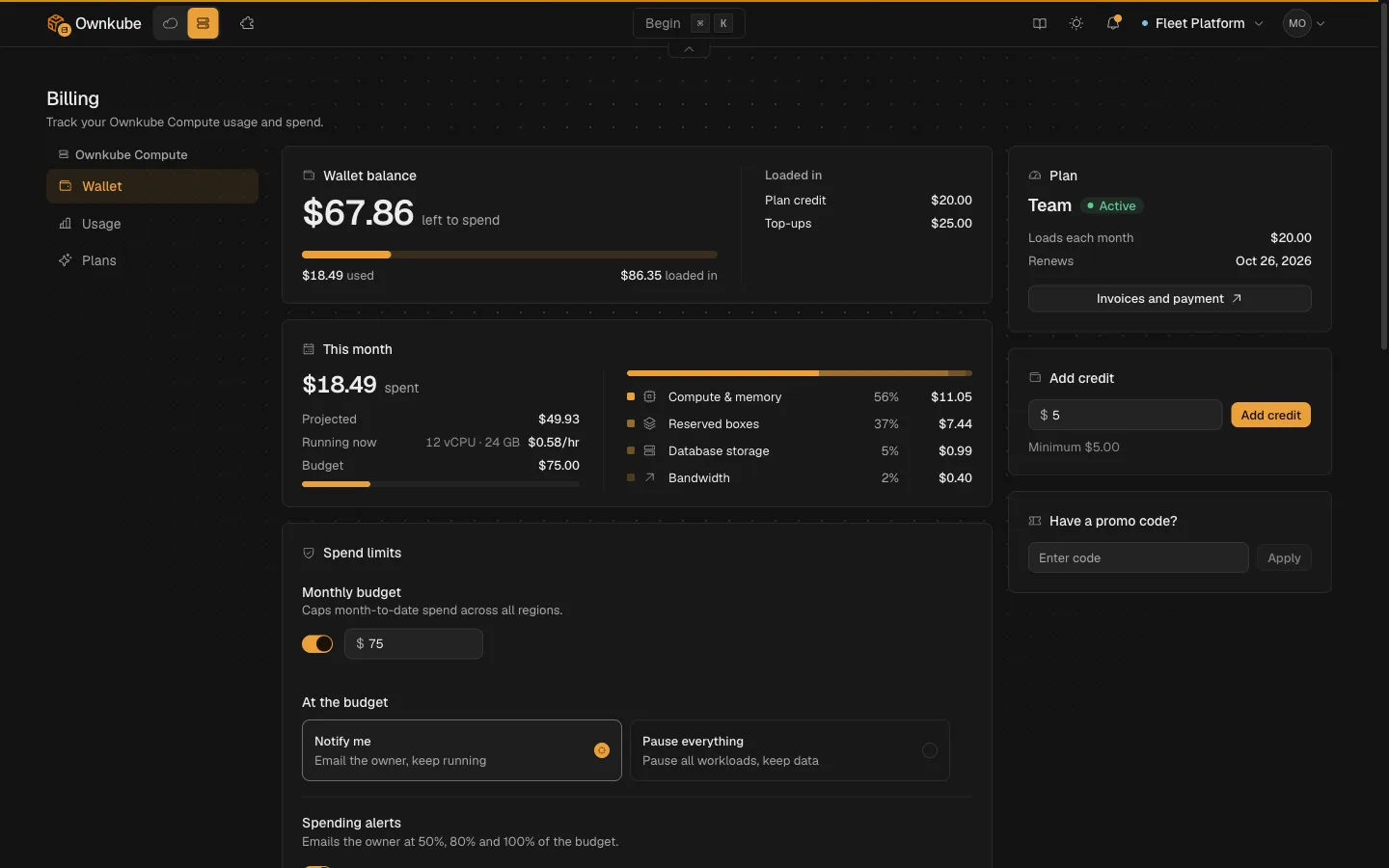
Ownkube meters CPU and memory per minute like Railway, at lower rates (about $18 per vCPU and $4.50 per GiB a month), and runs Postgres on flat boxes like Render, from $4 a month plus $0.25 per GB. Usage draws a prepaid wallet, so the bill can never run past what you loaded, and unused credit rolls over and never expires. The app + Postgres stack above comes to about $12.20 a month, and the four-service backend to about $54. Deploy my first app.
Abhishek Jaiswal · Founder and Engineer
Abhishek Jaiswal is the founder and engineer behind Ownkube, a cloud for personal software. He builds the platform and writes here about cloud cost, migrations, and running production infrastructure in your own AWS account without a DevOps team.