
 Abhishek Jaiswal
The best Heroku alternatives in 2026 are Ownkube, Render, Railway, Fly.io and DigitalOcean App Platform. Ownkube is the closest swap if you want the Heroku workflow (push a repo, get a URL, add Postgres) at a lower total: the small production stack priced below comes to about $178 a month on Heroku and about $57 on Ownkube. Render is the most Heroku-like in pricing shape, Railway has the fastest setup, and Fly.io suits apps spread across continents. Heroku is still a good place to be for some teams, so this post also covers when to stay.
Our picks
| If you want | Pick |
|---|---|
| The Heroku workflow, Postgres and a cache, at a lower full-stack total | Ownkube |
| Fixed instance prices that read like a dyno price list | Render |
| The fastest setup and a big template catalog | Railway |
| Low latency on several continents | Fly.io |
| To stay next to your existing DigitalOcean resources | DigitalOcean App Platform |
| Salesforce integration and the add-on marketplace you already use | Stay on Heroku |
The Heroku alternatives at a glance
Prices are approximate list prices from each provider’s pricing page, as of October 2026.
| Alternative | Billing model | Smallest always-on service | Managed Postgres | Cache | Best for |
|---|---|---|---|---|---|
| Ownkube | Prepaid wallet, metered per minute or a flat box per app | Metered from cents, or a Spark 1 box at $5 a month | From $4 a month plus $0.25 per GB | Valkey from $2 a month | Personal software and small teams |
| Render | Workspace plan plus flat instances | $7 a month (0.5 CPU, 512 MB) | From $6 a month | Key Value from $10 | Steady services |
| Railway | Metered per second | Whatever it uses, from cents | Metered service | Metered service | Fast setup |
| Fly.io | Machines per second | $2.19 a month (256 MB) | Managed from $38 a month | Bring your own | Global apps |
| DigitalOcean App Platform | Flat container tiers | $5 a month | From $15.15 a month | Managed, priced separately | DigitalOcean users |
| Heroku | Flat dynos plus add-ons | Basic dyno, $7 a month (512 MB) | Essential-0 from $5 a month | Key-Value Mini $3 | Salesforce-centric teams |
Why people look for a Heroku alternative
Memory per dollar. A Standard-1X dyno is $25 a month for 512 MB, and Standard-2X is $50 for 1 GB. The same $25 buys 2 GB on Render. Once a team runs a few web dynos and workers, that ratio becomes most of the bill.
There is no free tier. The cheapest dyno is Eco at $5 a month, and it sleeps after 30 minutes of inactivity. Basic at $7 stays up.
Add-ons add up. Logging, search, monitoring and the cache are each a separate add-on with its own price. A real app collects several.
The roadmap is quiet for small teams. New work at Heroku centers on Salesforce and enterprise buyers, which leaves small apps further from the middle of the roadmap.
The alternatives, one by one
Ownkube
Ownkube is a cloud for personal software, and it keeps the part of Heroku people liked. You connect a GitHub or GitLab repo, every push builds and deploys, and the app gets an *.ownkube.app hostname with TLS. A Dockerfile is optional. Web apps, workers, cron jobs, Postgres and a Valkey cache sit side by side on one canvas.
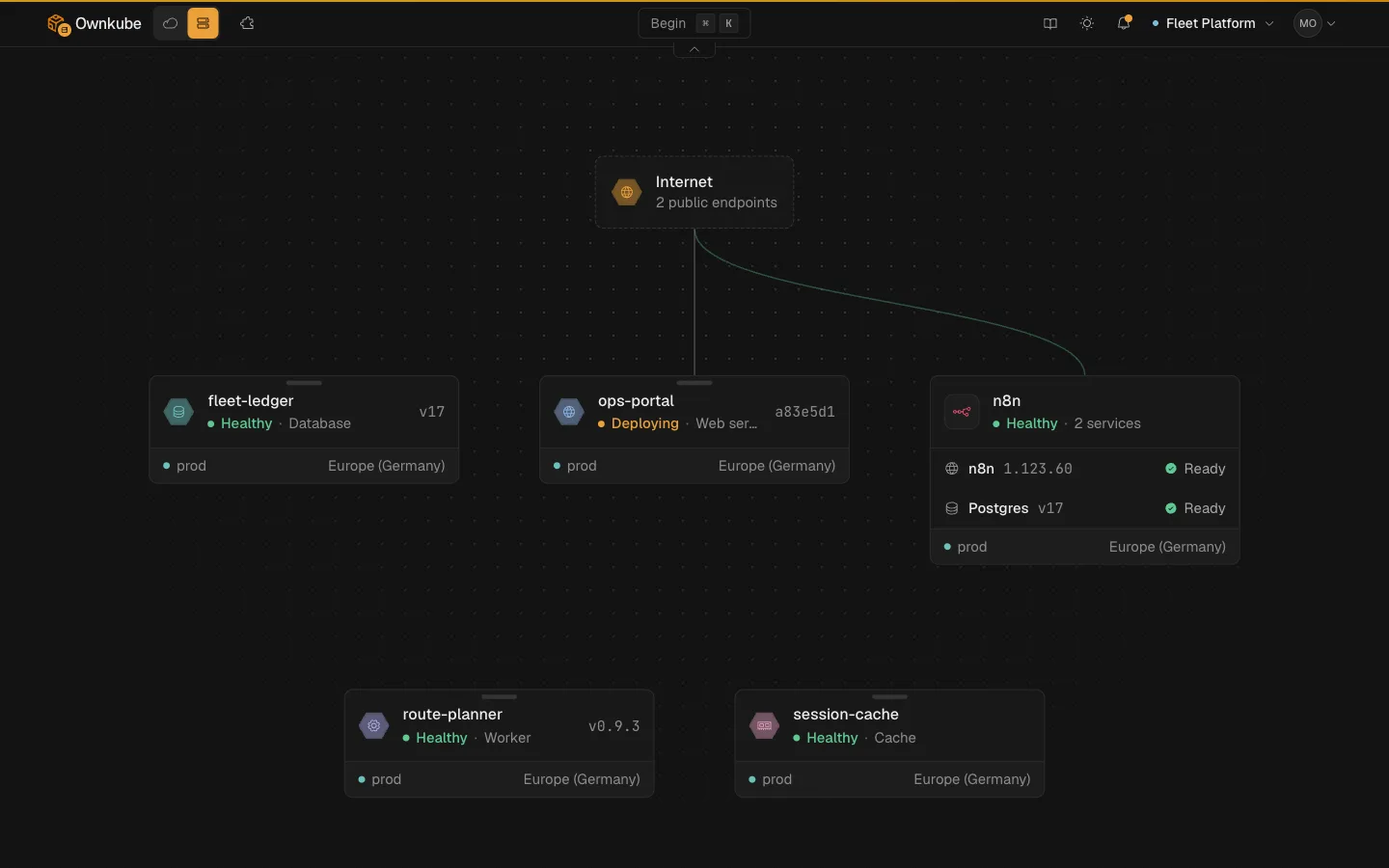
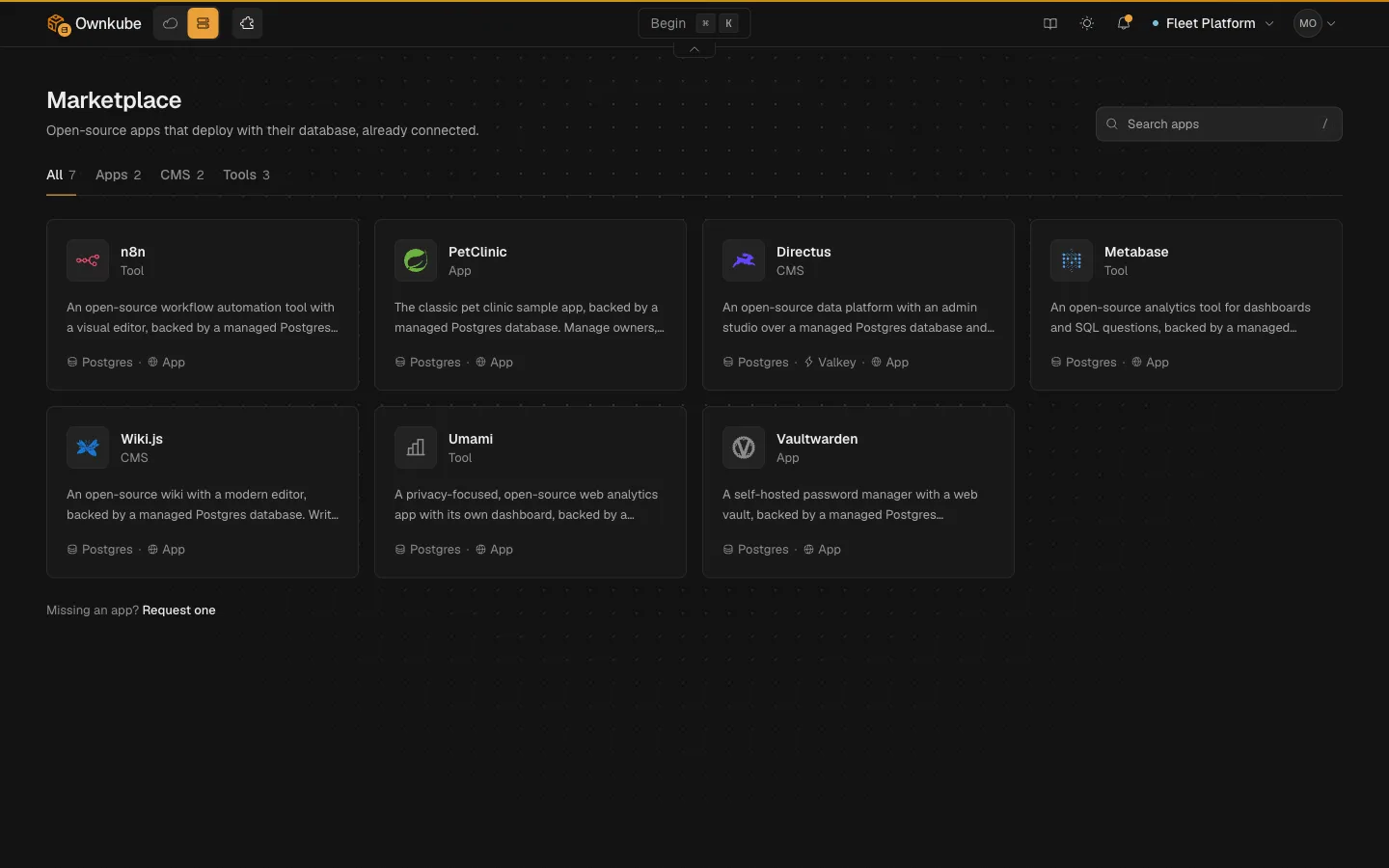
Where Heroku sells add-ons, Ownkube includes the basics: logs, CPU and memory metrics, request rates, alerts and rollback to recent builds come with every app. The Marketplace deploys open-source apps such as n8n, Directus, Metabase and Umami with their database already connected.
Billing is a prepaid wallet. Pay as you go starts with a $5 top-up, Personal ($5 a month) and Team ($20 a month) load credit each month, and unused credit never expires. Apps meter CPU and memory per minute on actual use (about $18 per vCPU and $4.50 per GiB a month), or sit on a flat box like a dyno (Spark from $5, Core from $58). Postgres runs on a database box from $4 a month plus $0.25 per GB of storage, with 7-day backups on paid plans. See managed Postgres pricing across eight providers for how that compares.
The trade-offs: Ownkube Compute runs in two regions (Mumbai and Germany), there is no add-on marketplace for third-party services, and custom domains are not on Compute yet. When an app has to move into your own or a customer’s AWS account, the same app ships there with no rewrite, and its logs, metrics and health checks come with it.
Render
Render is the most common Heroku replacement because the pricing shape matches: a flat price per instance, plus a workspace plan. You get more memory per dollar, and Postgres scales in smaller steps. See Render vs Heroku.
Railway
Railway meters usage per second and has excellent onboarding and templates. It is a good fit for many small, mostly idle services. See Railway alternatives for its trade-offs.
Fly.io
Fly.io runs Machines in dozens of regions. It is the pick when latency on several continents matters, and its managed Postgres from about $38 a month is the line to check. See Fly.io pricing explained.
DigitalOcean App Platform
Flat container tiers from $5 a month and managed databases from about $15. A sensible move if your other infrastructure is on DigitalOcean.
A small production stack, priced
Two web processes at 1 GB, one 512 MB worker, a Postgres with 4 GB of memory and 20 GB of data, and a small cache. Heroku and Ownkube figures assume the apps run all month; the Ownkube web and worker lines assume an average of a quarter of a vCPU each, since metered CPU follows actual use.
| Line | Ownkube | Heroku |
|---|---|---|
| Web | 2 apps, metered, about $18 | 2 x Standard-2X, $100 |
| Worker | Metered, about $4 | Standard-1X, $25 |
| Postgres | DB 4 box $28 plus 20 GB at $0.25, $33 | Standard-0, $50 |
| Cache | Cache 0.25 box, $2 | Key-Value Mini, $3 |
| Total | about $57, plus bandwidth | about $178 |
Heroku figures are approximate, as of October 2026. A busier app moves the Ownkube compute lines up; a Core box fixes them at a flat price if you prefer. Run your own sizes on the homepage calculator.
When to stay on Heroku
Stay if your team runs on Salesforce and uses Heroku Connect or the data integrations. Stay if your app depends on several third-party add-ons that would each need a new home. Stay if the bill is small, stable and nobody has time to migrate, since a working app on a known platform is worth something.
A quick checklist before you switch
- List every add-on and decide where each one goes.
- Export Postgres with
pg_dumpand test the restore on the new platform. - Copy config vars into environment variables.
- Check whether a
Procfileprocess maps to a web app, a worker or a cron job. - Keep the Heroku app running until the new one has served real traffic.
FAQ
What is the cheapest Heroku alternative?
For a full stack with Postgres and a cache, Ownkube comes out cheapest in our comparison. For a single tiny process, Fly.io’s 256 MB Machine at about $2 a month is hard to beat. Price the whole app, since the database and cache are where totals diverge.
Does Heroku have a free tier in 2026?
No. The cheapest option is the Eco dyno at $5 a month, which sleeps after 30 minutes of inactivity. Ownkube Compute has no free tier either: Pay as you go starts with a $5 top-up, and that credit never expires.
Do I need a Dockerfile to move from Heroku?
No. Ownkube builds from your repo with automatic build, the way Heroku buildpacks did, and uses your Dockerfile if you have one. The migration guide walks through each step.
Reference: for the side-by-side breakdown, see Ownkube vs Heroku in the docs.
Where Ownkube fits
Move off Heroku when the dyno and add-on lines cost more than the workflow is worth to you. Stay when Salesforce integration is the reason you are there. Ownkube is built for personal software and small teams: push a repo, get a URL, run Postgres from $4 a month, and keep the credit you do not spend. Deploy my first app.
Abhishek Jaiswal · Founder and Engineer
Abhishek Jaiswal is the founder and engineer behind Ownkube, a cloud for personal software. He builds the platform and writes here about cloud cost, migrations, and running production infrastructure in your own AWS account without a DevOps team.