
 Abhishek Jaiswal
Render is the platform most often picked as a Heroku replacement, and for good reason: both sell fixed-size instances at a flat monthly price, both run web services, workers, cron jobs and Postgres, and the workflow of pushing a repo and getting a URL is the same. The difference is how much you get for the money, and how each handles databases, free tiers and teams. This post compares them line by line with list prices checked on 2026-10-13, then works one production bill on both.
TL;DR
- Memory per dollar is the headline. Heroku Standard-1X is $25 a month for 512 MB. Render’s 1c-2g instance is $25 a month for 1 CPU and 2 GB.
- The entry tiers are close. Heroku Eco is $5 (sleeps after 30 minutes) and Basic $7, both 512 MB. Render’s smallest paid instance is $7 for 0.5 CPU and 512 MB, and its free instances spin down after 15 minutes.
- Postgres starts cheaper on Heroku (Essential-0 at $5 with 1 GB of storage) and scales more gradually on Render (from $6, priced by instance plus $0.30 per GB).
- A typical production stack prices at about $178 a month on Heroku and about $153 on Render Pro.
How do Heroku dynos compare with Render instances?
| Heroku dyno | Memory | Price | Render instance | Price |
|---|---|---|---|---|
| Eco (sleeps) | 512 MB | $5 | Free (spins down) | $0 |
| Basic | 512 MB | $7 | 0.5c-512mb | $7 |
| Standard-1X | 512 MB | $25 | 1c-2g | $25 |
| Standard-2X | 1 GB | $50 | 2c-4g | $85 |
| Performance-M | 2.5 GB | $250 | 2c-8g | $135 |
| Performance-L | 14 GB | $500 | 4c-16g | $225 |
Render also charges a workspace plan: Hobby is $0, Pro $25 a month, and Scale $499. Heroku has no separate workspace fee for the dynos above.
How does Postgres compare?
| Heroku Postgres | Storage | Price | Render Postgres | Price |
|---|---|---|---|---|
| Essential-0 | 1 GB, 20 connections | $5 | 0.1c-256mb | $6 + storage |
| Essential-1 | 10 GB, 20 connections | $9 | 0.5c-1g | $19 + storage |
| Essential-2 | 32 GB, 40 connections | $20 | 1c-2g | $40 + storage |
| Standard-0 | 64 GB, 200 connections | $50 | 1c-4g | $55 + storage |
Render storage is $0.30 per GB. Heroku’s Essential plans include storage and cap connections, so watch the 20-connection limit if your app runs several dynos with connection pools. For a Redis-compatible cache, Heroku Key-Value Store starts at $3 (Mini, 25 MB) and Render Key Value at $10 (256 MB).
How do the free tiers compare?
Heroku has no free tier. Eco dynos cost $5 a month for a shared pool of hours and sleep after 30 minutes of inactivity. Render’s free web services spin down after 15 minutes without inbound traffic, take about a minute to wake, and share 750 free instance hours a month per workspace. Render’s free Postgres expires after 30 days.
What does a production app cost on each?
Two web instances with about 1 GB each, one background worker, a Postgres with about 4 GB of memory and 20 GB of data, and a small cache:
| Line | Heroku | Render (Pro) |
|---|---|---|
| Workspace plan | none | $25 |
| Web | 2 x Standard-2X = $100 | 2 x 1c-2g = $50 |
| Worker | Standard-1X = $25 | 0.5c-512mb = $7 |
| Postgres | Standard-0 = $50 | 1c-4g $55 + 20 GB $6 = $61 |
| Cache | Key-Value Mini = $3 | Key Value = $10 |
| Total | about $178 | about $153 |
Render’s web instances carry more memory for the money, which outweighs its workspace fee and pricier small cache at this size. The gap widens as you scale up: Heroku’s Performance dynos cost roughly twice Render’s instances of similar memory.
What does Heroku still do better?
- The add-on marketplace. Logging, monitoring, search, email and dozens of databases attach with one command and bill on the Heroku invoice.
- Pipelines and review apps. Promotion from staging to production and a disposable app per pull request are mature, well-documented features.
- Longevity. Heroku has run production apps since 2007, and its buildpacks and Procfile conventions are known to every Rails and Node developer.
How do I move from Heroku to Render?
- Map the Procfile. Each process type (
web,worker) becomes a Render service with the same start command. - Copy the config vars. Export them with
heroku configand add them as environment variables, or define them in arender.yamlBlueprint. - Move the database. Take a backup with
heroku pg:backups:capture, download it, and restore it into Render Postgres withpg_restore. - Recreate scheduled jobs. Heroku Scheduler tasks become Render cron jobs.
- Switch DNS once the new services are healthy.
FAQ
Is Render cheaper than Heroku?
At most sizes, yes. Render’s 1c-2g instance costs $25 a month, the same as Heroku’s 512 MB Standard-1X. At the smallest sizes they are close: Heroku Basic and Render’s 0.5c-512mb are both $7. Heroku’s Postgres starts cheaper at $5.
Does Heroku have a free tier in 2026?
No. The cheapest option is the Eco plan at $5 a month, whose dynos sleep after 30 minutes of inactivity. Basic dynos at $7 a month do not sleep.
Is Render a good Heroku alternative?
For most apps, yes. It keeps the Heroku model of fixed instances, workers, cron jobs and managed Postgres, at more memory per dollar. Teams that depend on Heroku’s add-on marketplace or pipelines have more to rebuild.
Can I use a Procfile on Render?
Render does not read the Procfile directly. Each process type becomes its own service with the same start command, and a render.yaml Blueprint can describe them all in one file.
Where Ownkube fits
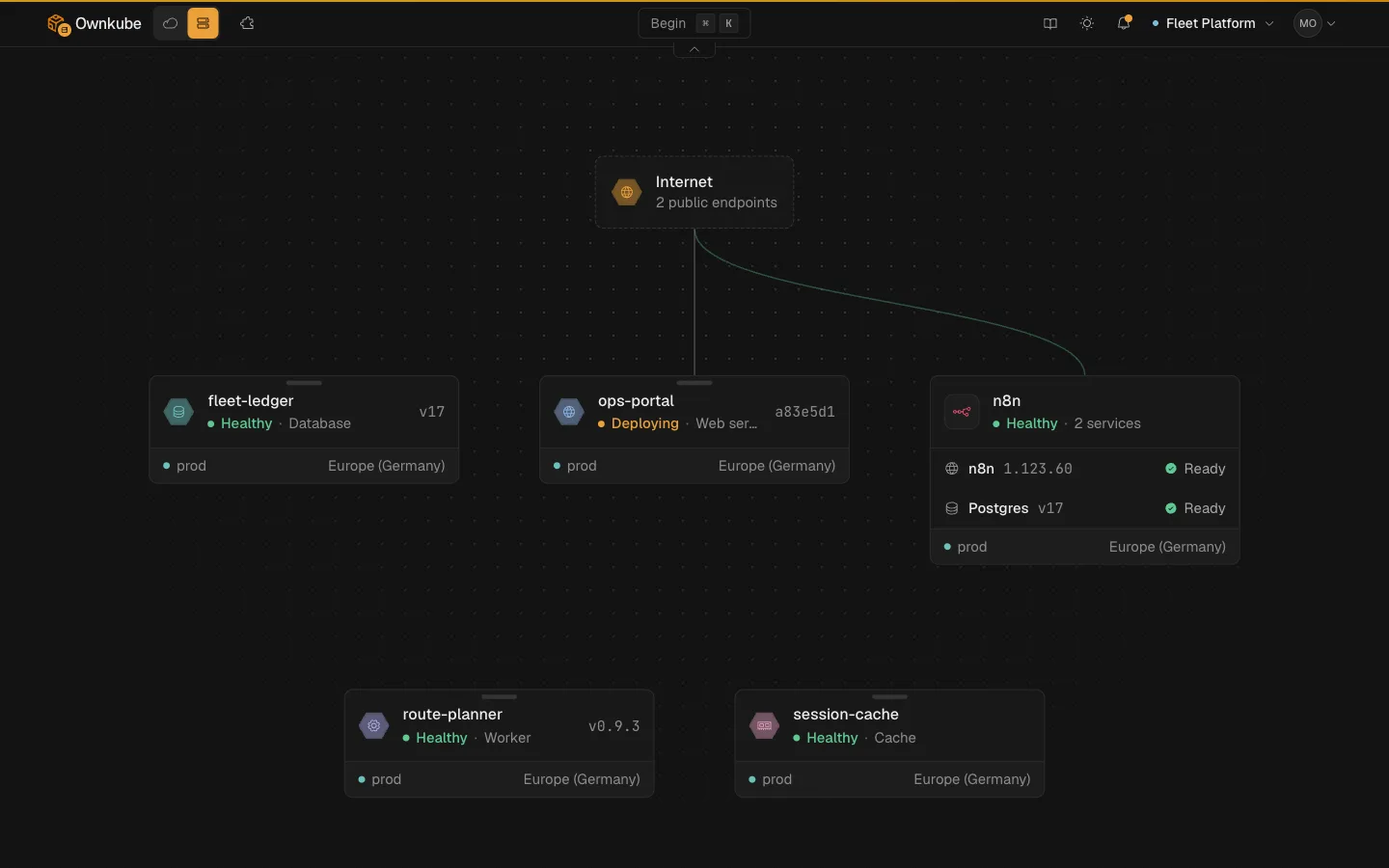
Ownkube keeps the Heroku workflow (push a repo, link Postgres, add a worker) and bills differently: CPU and memory are metered per minute at about $18 per vCPU and $4.50 per GiB a month, and databases run on flat boxes from $4 a month plus $0.25 per GB. The production stack above (web services averaging 0.25 vCPU and 1 GiB each, a light worker, a DB 4 box with 20 GB and a small cache) comes to about $57 a month, drawn from a prepaid wallet where unused credit never expires. The Heroku alternatives guide and the Rails hosting page have more detail. Deploy my first app.
Abhishek Jaiswal · Founder and Engineer
Abhishek Jaiswal is the founder and engineer behind Ownkube, a cloud for personal software. He builds the platform and writes here about cloud cost, migrations, and running production infrastructure in your own AWS account without a DevOps team.