
 Abhishek Jaiswal
Railway and Fly.io both run your containers without a cluster to manage, and they come at it from different directions. Railway is dashboard first: a project canvas, templates, and usage metered per second. Fly.io is infrastructure first: you run Machines, small VMs you size and place in the regions you choose, configured through fly.toml and the flyctl CLI. This post compares how each prices, how they handle databases and idle apps, and which fits which kind of project. Prices were checked on 2026-10-13.
TL;DR
- Railway bills usage at about $20 per vCPU and $10 per GB of memory a month. Hobby is $5 with $5 of usage included. It is the easier of the two to start with.
- Fly.io bills each Machine by size while it runs, from $2.19 a month for shared-cpu-1x with 256 MB. Stopped Machines bill no CPU or memory. It is the stronger choice for apps that need to run close to users in several regions.
- Postgres is the biggest price gap. Fly’s Managed Postgres starts at $38 a month. Railway runs Postgres as a metered service, so a small database costs a few dollars.
- For a small app with a database, Railway is cheaper. For a single tiny always-on app, Fly is cheaper.
How do Railway and Fly.io price?
| Railway | Fly.io | |
|---|---|---|
| Billing model | Metered CPU and memory per second | Machine size per second while running |
| Plans | Free ($1 credit a month), Hobby $5, Pro $20 | Pay as you go; support plans from $29 |
| Smallest service | Whatever it uses, from cents | shared-cpu-1x 256 MB at $2.19 a month |
| Typical sizes | about $20 per vCPU, $10 per GB a month | 512 MB $3.69, 1 GB $6.70, shared-cpu-2x 2 GB $13.39, performance-1x 2 GB $33 |
| Idle apps | Optional Serverless sleep after 5 to 10 minutes without outbound traffic | Autostop stops or suspends Machines; stopped Machines bill only their root disk at $0.15 per GB |
| Volumes | about $0.15 per GB | $0.15 per GB |
| Egress | $0.05 per GB | $0.02 per GB in North America and Europe, $0.04 in Asia Pacific, $0.12 in Africa and India |
| Extras | Included | Dedicated IPv4 $2 a month |
Fly’s Machine prices also vary by region: a 1 GB Machine is $7.73 a month in Frankfurt and $8.50 in Singapore.
Which is cheaper, Railway or Fly.io?
| Workload | Railway | Fly.io |
|---|---|---|
| Small always-on app (512 MB, 0.1 vCPU average) | about $7 on Hobby | $3.69 |
| App + Postgres (app 0.25 vCPU / 0.5 GB, 5 GB database, 10 GB egress) | about $18.25 | about $42 with Managed Postgres |
| A 24/7 Discord bot | inside the $5 Hobby plan | Fly’s own example: $2.21 |
Fly wins on a single small Machine, because a fixed 512 MB size costs less than Railway’s memory rate. Railway wins as soon as a managed database joins, because Fly’s Managed Postgres starts at $38. You can run Postgres yourself on a Fly Machine with a volume for a few dollars, and then backups, failover and upgrades are yours.
Fly.io pricing explained and Railway pricing explained walk through each bill in detail.
How do regions compare?
Fly.io is built around placing Machines in many regions and routing each user to the nearest one through its Anycast network. Running the same app in three regions is a fly scale count command away, and a read replica of your database can sit next to each copy. Railway lets you choose a region per service and is the simpler model for an app that serves one market.
If your users are spread across continents and latency matters, Fly has the edge. If they are mostly in one region, the multi-region model is complexity you do not need.
How do the developer experiences compare?
- Railway is configured in the dashboard: a canvas of services, one-click templates, variables shared across services, and preview environments per pull request. Most people deploy their first app without reading docs.
- Fly.io is configured in
fly.tomland driven byflyctl. You get fine control over Machines, volumes, health checks, and placement. Expect to read the docs and to run a few CLI commands for things the Railway dashboard does with a click.
Railway or Fly.io: which should you pick?
| If you | Pick |
|---|---|
| Want the fastest path from repo to URL | Railway |
| Need an app and a managed Postgres on a small budget | Railway |
| Serve users on several continents | Fly.io |
| Run one tiny always-on process | Fly.io |
| Prefer configuration as code and a CLI | Fly.io |
FAQ
Is Fly.io cheaper than Railway?
For a single small always-on app, yes: a 512 MB Machine is $3.69 a month, against about $7 of Railway usage for the same memory. With a managed database, Railway is cheaper, because Fly’s Managed Postgres starts at $38 a month.
Does Fly.io have a free tier?
Fly.io is pay as you go. Small Machines cost a few dollars a month, and stopped Machines bill only their root disk storage.
Can Railway run in multiple regions like Fly.io?
Railway lets you pick a region for each service. Fly.io is designed around running copies of an app in many regions with Anycast routing to the nearest one, which suits globally distributed apps better.
Is it easy to move between Railway and Fly.io?
Both run containers from a Dockerfile, and Railway also builds without one. Moving means recreating services and variables, copying the database with pg_dump and pg_restore, and switching DNS.
Where Ownkube fits
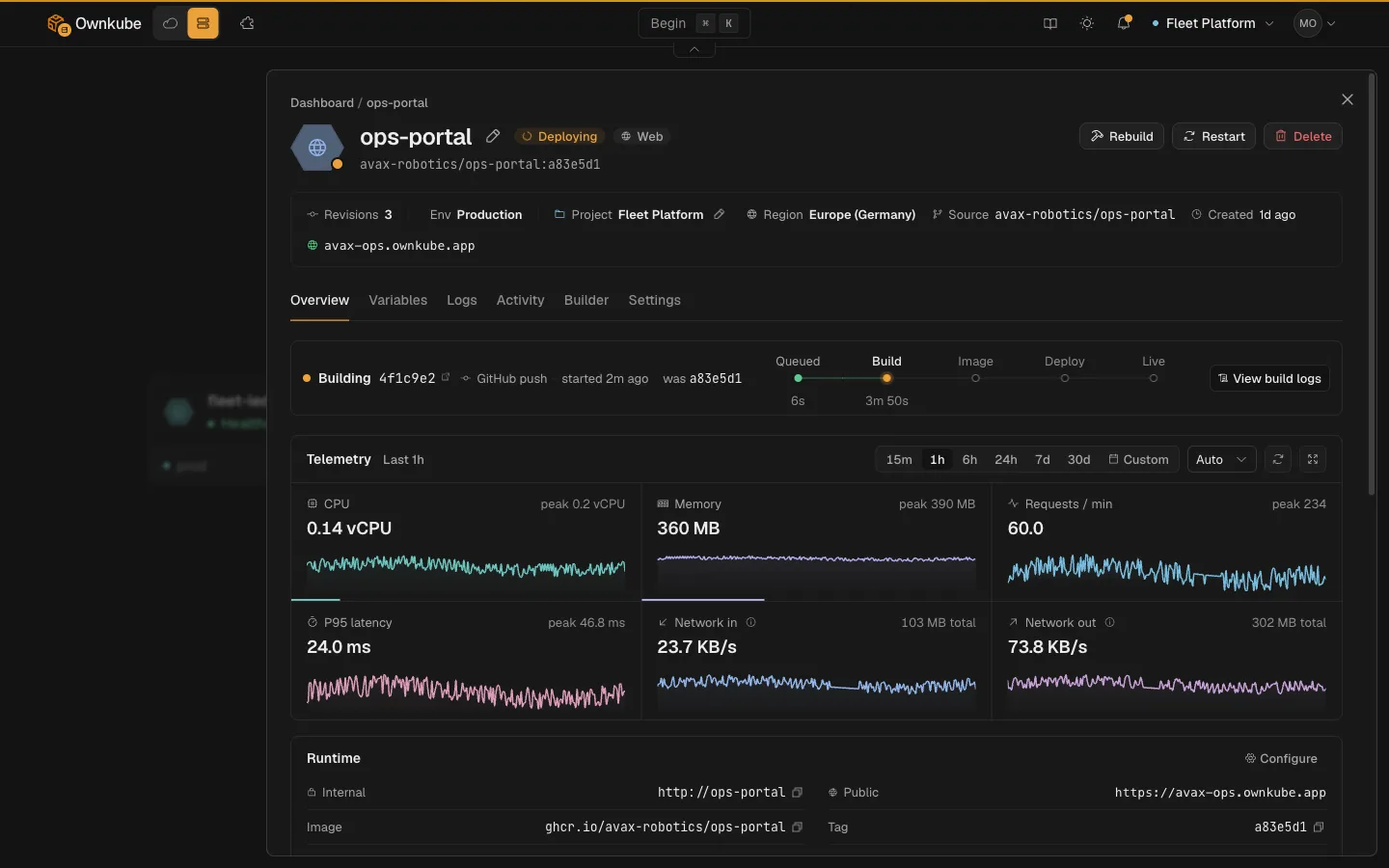
Ownkube sits between the two on price and closer to Railway on experience. CPU and memory are metered per minute at about $18 per vCPU and $4.50 per GiB a month, and managed Postgres runs on a flat box from $4 a month plus $0.25 per GB, with backups on the Personal and Team plans. The app + Postgres stack above comes to about $12.20 a month in the Germany region. Usage draws a prepaid wallet, so the bill never runs past what you loaded, and credit never expires. See Fly.io alternatives for more options. Deploy my first app.
Abhishek Jaiswal · Founder and Engineer
Abhishek Jaiswal is the founder and engineer behind Ownkube, a cloud for personal software. He builds the platform and writes here about cloud cost, migrations, and running production infrastructure in your own AWS account without a DevOps team.