
 Abhishek Jaiswal
Railway and Vercel show up in the same searches, and they overlap less than it seems. Vercel is a frontend cloud: it builds Next.js and other frameworks, serves them from a global edge network, and runs your server code as functions that start per request. Railway runs long-lived containers: API servers, workers, cron jobs and databases that stay up between requests. Many teams use both. This post explains where each fits, compares the limits and pricing that matter, and covers the split setup. Prices and limits were checked on 2026-10-13.
TL;DR
- Vercel is the better home for a Next.js or other frontend: preview deployments per branch, a global CDN, image optimization and zero server management. Server code runs as functions with a duration limit of 300 seconds on Hobby and 800 on Pro.
- Railway is the better home for anything long-running: API servers, WebSocket servers, queue workers, bots, cron jobs and databases.
- Vercel’s Hobby plan is free for personal, non-commercial use. Pro is $20 per seat a month with $20 of usage included. Railway Pro is $20 per workspace with $20 of usage included.
- A common setup is the frontend on Vercel and the API and Postgres on Railway, in nearby regions.
What is each one built for?
| Vercel | Railway | |
|---|---|---|
| Core model | Static assets on a CDN plus functions per request | Containers that run continuously |
| Best at | Next.js, frontends, server rendering, edge middleware | APIs, workers, cron jobs, databases, bots |
| Server code | Functions with a maximum duration | Any process, no time limit |
| WebSockets | Public beta on Vercel Functions | Supported natively by any server |
| Databases | Through Marketplace integrations, billed by the provider | Postgres, MySQL, Redis and others as services in your project |
| Background jobs | Cron jobs that call functions; Workflows for long tasks | Workers and cron services |
What are Vercel’s function limits?
Vercel Functions run with these limits on fluid compute:
| Hobby | Pro | |
|---|---|---|
| Maximum duration | 300 seconds | 800 seconds, 1800 in beta |
| Maximum memory | 2 GB, 1 vCPU | 4 GB, 2 vCPU |
| Request or response body | 4.5 MB | 4.5 MB |
Anything that has to run longer, hold a connection open for hours, or keep state in memory between requests fits a long-running server better. That is Railway’s home ground.
How do Railway and Vercel price?
| Vercel | Railway | |
|---|---|---|
| Free | Hobby: free for non-commercial use, with included limits | Free plan: $1 of credit a month after a $5 trial |
| Paid plan | Pro: $20 per seat a month, $20 of usage included | Hobby $5 with $5 of usage; Pro $20 per workspace with $20 of usage |
| Compute | Active CPU from $0.128 per hour, memory from $0.0106 per GB-hour | about $20 per vCPU and $10 per GB a month |
| Requests | Invocations from $0.60 per million | Included |
| Bandwidth | 1 TB on Pro, then from $0.15 per GB | $0.05 per GB |
The per-seat model is the line to watch. A team of five on Vercel Pro pays $100 a month in seats before usage. Railway’s Pro fee is per workspace.
Can Railway host Next.js?
Yes. Railway runs Next.js as a Node server with next start, including server rendering, API routes and middleware. You give up Vercel’s per-branch preview URLs on its global edge, image optimization at the CDN, and the zero-configuration build, and you gain a server with no function time limits and flat usage pricing.
Can Vercel host my backend?
For an API made of short request handlers, yes: Vercel Functions run Node.js, Python, Go and other runtimes. It stops fitting when you need a process that runs continuously, a queue consumer, a Discord bot, a server holding many WebSocket connections, or a database. Those need a host like Railway.
How do I use Vercel and Railway together?
- Deploy the frontend to Vercel and the API, workers and Postgres to Railway.
- Pick regions close to each other. Vercel Functions run in a single region by default, so match your Railway region to it to keep each API call short.
- Point the frontend at the API with an environment variable, and allow the Vercel domain in the API’s CORS settings.
- Keep secrets for the database on the Railway side only. The frontend talks to your API, never to the database directly.
Railway or Vercel: which should you pick?
| If you are building | Pick |
|---|---|
| A Next.js marketing site or frontend | Vercel |
| A REST or GraphQL API with Postgres | Railway |
| A full-stack Next.js app with a database | Vercel for the app plus a database provider, or Railway for both |
| Workers, bots, cron jobs | Railway |
| A commercial project on a free plan | Neither: Vercel Hobby is non-commercial, and Railway’s free credit is $1 a month |
The Vercel alternatives guide covers more backend options next to Vercel, including Netlify.
FAQ
Is Railway a Vercel alternative?
For backends and long-running services, yes. For frontends, Railway can run Next.js as a server, but it lacks Vercel’s global edge network and per-branch preview URLs on a CDN. Many teams use Vercel for the frontend and Railway for the backend.
Can I use Vercel Hobby for a commercial project?
No. Vercel’s Hobby plan is for personal, non-commercial use. Commercial projects need Pro at $20 per seat a month.
Does Vercel support WebSockets?
WebSocket support on Vercel Functions is in public beta on all plans. For a server that holds many long-lived connections, a long-running host is still the more predictable choice.
Which is cheaper, Railway or Vercel?
They bill different things. For a frontend with mostly static pages, Vercel’s included usage often covers it. For an always-on API or worker, Railway’s metered containers are cheaper than keeping functions busy, and Railway does not charge per seat.
Where Ownkube fits
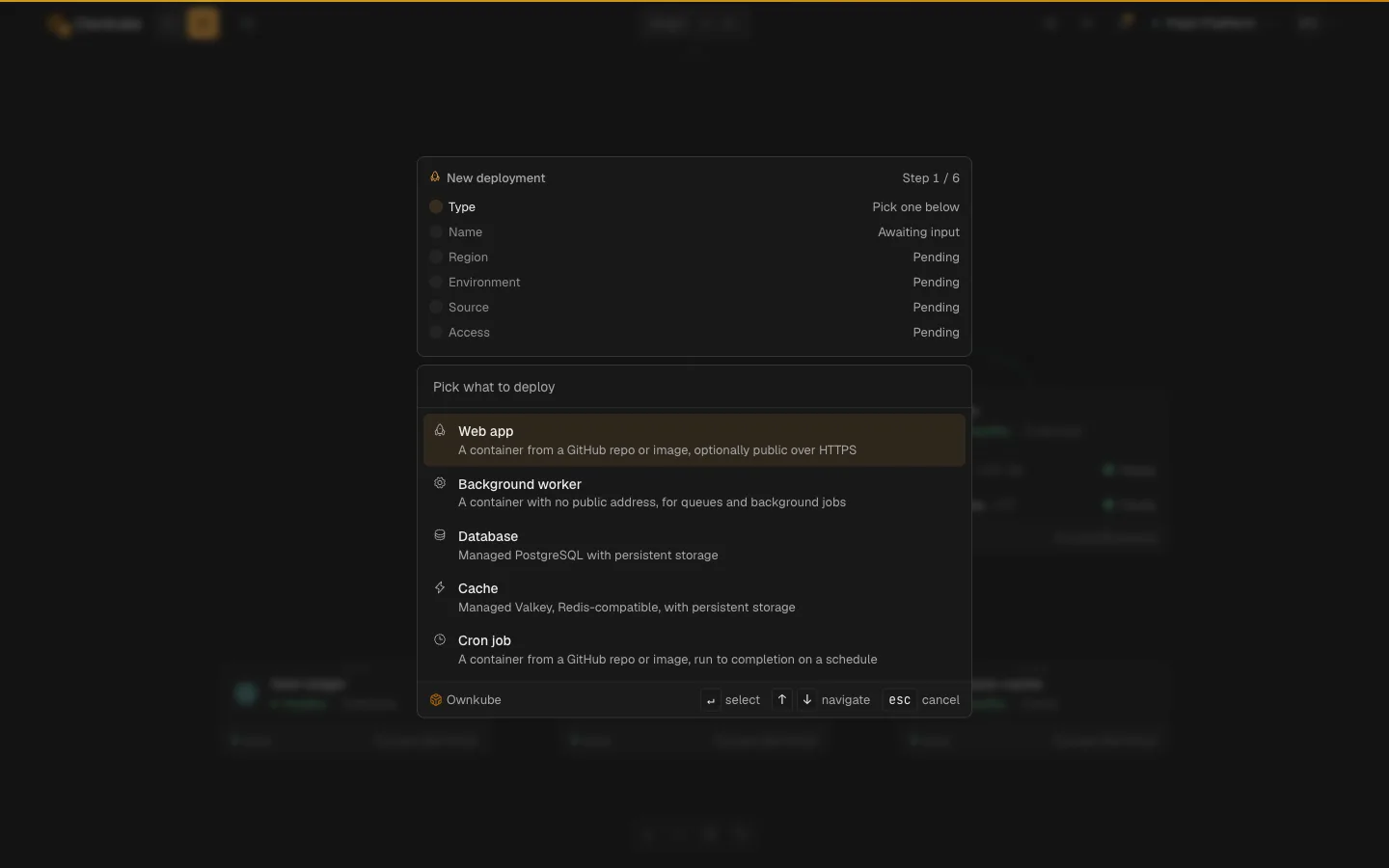
Ownkube is a backend host in the Railway mold: web apps, workers, cron jobs, managed Postgres and a Valkey cache, built from your repo and served on a *.ownkube.app hostname with HTTPS. It runs next to a Vercel frontend the same way Railway does. Usage bills per minute from a prepaid wallet at about $18 per vCPU and $4.50 per GiB a month, with no per-seat fee, and unused credit never expires. Deploy my first app.
Abhishek Jaiswal · Founder and Engineer
Abhishek Jaiswal is the founder and engineer behind Ownkube, a cloud for personal software. He builds the platform and writes here about cloud cost, migrations, and running production infrastructure in your own AWS account without a DevOps team.