
 Abhishek Jaiswal
The best Vercel alternatives in 2026 are Ownkube, Netlify, Cloudflare Workers and Pages, Render, Railway and Fly.io. Which one fits depends on what you are moving. If it is the frontend alone, Netlify and Cloudflare are the closest swaps. If it is the backend that Vercel’s functions do not fit (workers, cron jobs, WebSockets, a Postgres next to the app), Ownkube runs the whole app, frontend and backend, as always-on containers from one prepaid wallet. Vercel is still the best home for many Next.js frontends, so this post also covers when to stay.
Our picks
| If you want | Pick |
|---|---|
| The whole app, workers, cron, Postgres and a cache in one place, with a bounded bill | Ownkube |
| A frontend platform close to Vercel’s workflow | Netlify |
| Edge functions and static assets on a global network | Cloudflare Workers and Pages |
| A few steady backend services at flat prices | Render |
| The fastest setup for many small services | Railway |
| Low-latency backends on several continents | Fly.io |
| Next.js with the newest framework features on day one | Stay on Vercel |
The Vercel alternatives at a glance
Prices are approximate, from each provider’s pricing page, as of October 2026.
| Alternative | Runtime model | Long-running processes | Managed Postgres | Billing | Best for |
|---|---|---|---|---|---|
| Ownkube | Always-on containers, idle apps can sleep | Yes, workers and cron jobs | From $4 a month plus $0.25 per GB | Prepaid wallet, metered per minute or a flat box | Full-stack apps, small teams |
| Netlify | Static assets plus functions | No, functions have time limits | Through integrations | Plan plus usage | Frontends |
| Cloudflare Workers and Pages | Edge functions plus static assets | Limited, through Durable Objects and queues | Through integrations | Workers paid plan from $5 a month plus usage | Edge logic |
| Render | Always-on containers | Yes | From $6 a month | Workspace plan plus flat instances, postpaid | Steady services |
| Railway | Always-on containers | Yes | Metered service | Metered per second, postpaid | Fast setup |
| Fly.io | Machines per region | Yes | Managed from $38 a month | Per second, postpaid | Global backends |
| Vercel | Static assets plus functions | No, functions run up to 800 seconds on Pro | Through Marketplace integrations | $20 per seat a month, plus usage | Next.js frontends |
Why people look for a Vercel alternative
The backend does not fit in a function. Vercel functions run up to 300 seconds on the free plan and 800 on Pro. Queue consumers, long imports, bots and WebSocket servers want a process that stays up.
The database lives somewhere else. Vercel connects Postgres through Marketplace providers, each billed by that provider. The app and its data end up on two bills and two dashboards.
Seats and bandwidth. Pro is $20 per seat a month, and bandwidth past the included 1 TB starts around $0.15 per GB. A busy API or a growing team moves both lines.
Commercial use. The free plan is for non-commercial projects, so a side project that starts earning needs a paid seat.
The alternatives, one by one
Ownkube
Ownkube is a cloud for personal software. It runs everything a Vercel app needs next to it: web apps (Next.js included), background workers with no public address, cron jobs, managed Postgres and a Valkey cache, all on Ownkube Compute with no cloud account to set up.
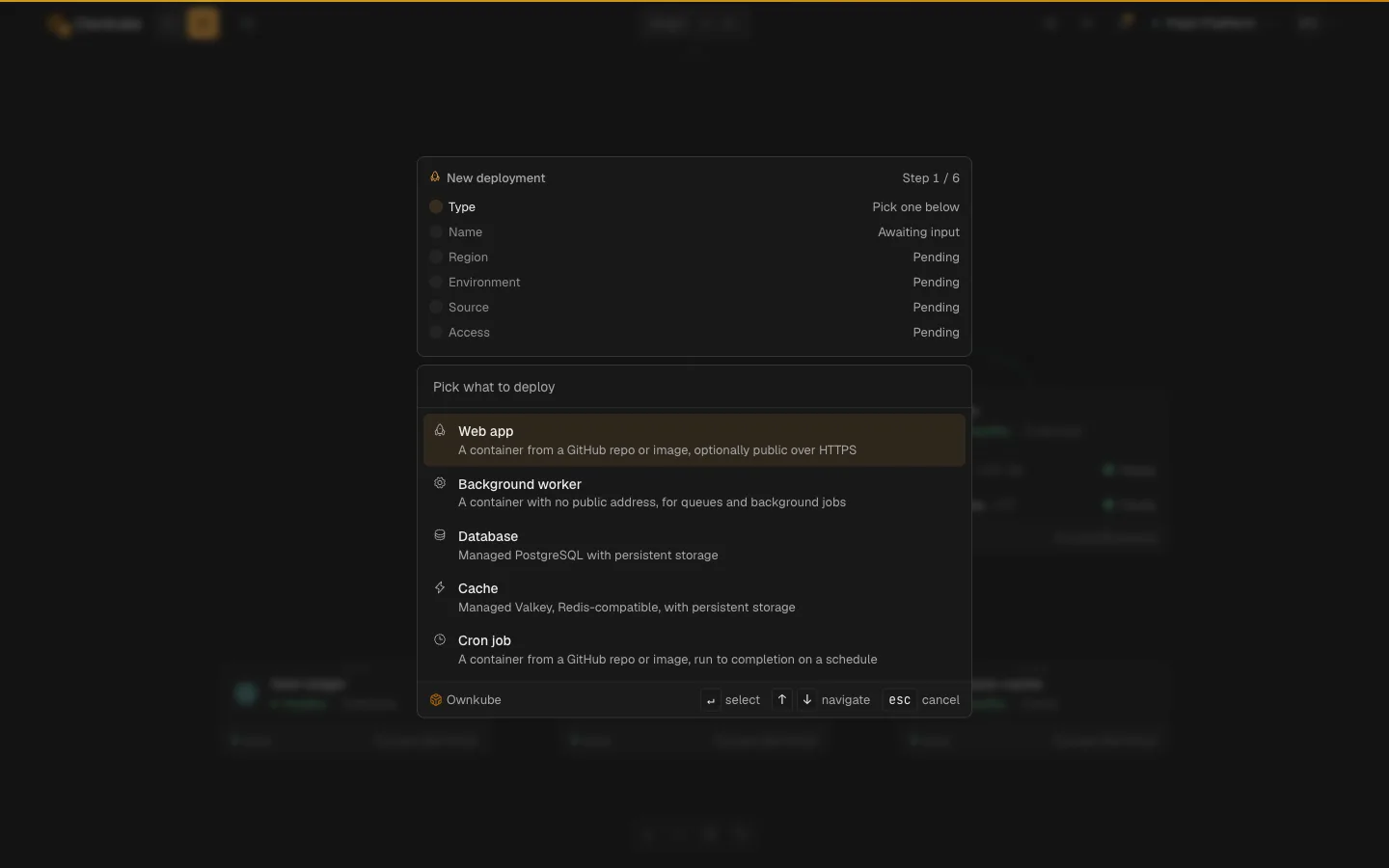
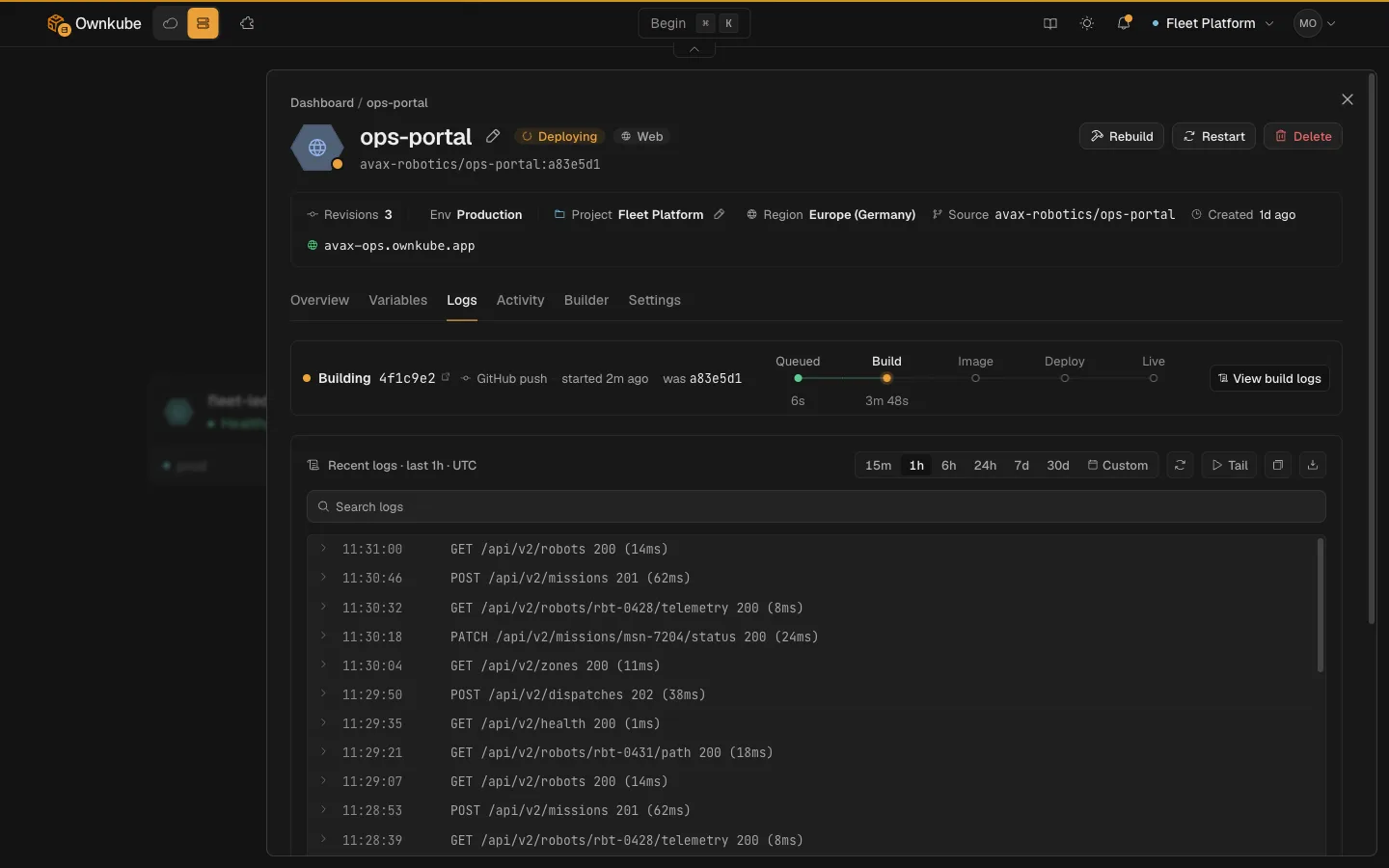
Every app is an always-on container, so a worker can run for hours and a WebSocket server can hold connections. Idle web apps, databases and caches can sleep: a sleeping app meters nothing, a sleeping database bills only its storage, and the next request wakes it. Logs are searchable per app and kept for 7 to 90 days depending on plan.
Billing is a prepaid wallet with no seats. Pay as you go starts with a $5 top-up, Personal ($5 a month) and Team ($20 a month) load credit each month, and unused credit never expires. Apps meter CPU and memory per minute (about $18 per vCPU and $4.50 per GiB a month) or sit on a flat box. Postgres starts at $4 a month plus storage, caches at $2.
The trade-offs: apps run in one of two regions (Mumbai and Germany) with no edge network in front, there are no per-branch preview deployments, and custom domains are not on Compute yet. A common split is to keep a static frontend on Vercel and run the API, workers and database on Ownkube. When the app later has to run in your own or a customer’s AWS account, the same app ships there with no rewrite, with its logs, metrics and health checks.
Netlify
Netlify is the closest to Vercel’s workflow for frontends: Git deploys, previews, functions and a CDN. It has the same shape of limits for long-running backend work.
Cloudflare Workers and Pages
Workers run at the edge in many cities with very fast cold starts, and Pages hosts static sites. Long-running work goes through Durable Objects and queues, which is a different programming model from a container.
Render
Render runs always-on web services, workers, cron jobs and Postgres at flat instance prices. A good home for a backend that is busy all day. See Render pricing explained.
Railway
Railway runs any process with no time limit, meters per second and sets up quickly. See Railway vs Vercel.
Fly.io
Fly.io runs Machines in dozens of regions, which suits a backend that has to sit close to users. Its managed Postgres starts around $38 a month.
Vercel vs Ownkube
| Ownkube | Vercel | |
|---|---|---|
| Runtime | Always-on containers, idle apps sleep | Functions plus static assets on a CDN |
| Long jobs | Workers and cron jobs, no time limit | Up to 800 seconds on Pro |
| Postgres | Built in, from $4 a month | Through Marketplace providers |
| Cache | Valkey from $2 a month | Through Marketplace providers |
| Pricing | Prepaid wallet, no seats | $20 per seat a month plus usage |
| Edge network and previews | No | Yes |
| Custom domains | Not on Compute yet | Yes |
Vercel figures are approximate, as of October 2026.
When to stay on Vercel
Stay if your app is mostly a Next.js frontend, since Vercel ships new framework features first and its edge network is hard to match. Stay if per-branch preview deployments are central to how your team reviews work. Stay if your backend already fits in functions and the bill is predictable.
A quick checklist before you move the backend
- List every function that runs longer than a few seconds or holds a connection.
- Decide which parts stay on the edge and which move to containers.
- Move Postgres next to the backend and test a
pg_dumprestore. - Point the frontend’s API base URL at the new backend and check CORS.
- Watch logs on both sides for a day before turning anything off.
FAQ
Can Ownkube host a Next.js app?
Yes. Ownkube builds a Next.js app from a GitHub or GitLab repo and runs it as an always-on web app with server rendering and API routes. See deploy a Next.js app.
What is the best Vercel alternative for background jobs?
Any platform that runs always-on containers: Ownkube, Render, Railway or Fly.io. Ownkube runs workers and cron jobs next to the app and its Postgres, billed from one wallet.
Is Ownkube cheaper than Vercel?
For a backend with a database and workers, usually, because there are no seats and Postgres starts at $4 a month. For a static or mostly cached frontend, Vercel’s free and Pro plans are hard to beat.
Reference: for the side-by-side breakdown, see Ownkube vs Vercel in the docs.
Where Ownkube fits
Move the backend off Vercel when it no longer fits in a function or the database lives on a different bill. Keep the frontend there if it works. Ownkube is built for personal software and small teams: run the whole app in one place, load a wallet instead of buying seats, and keep the credit you do not spend. Deploy my first app.
Abhishek Jaiswal · Founder and Engineer
Abhishek Jaiswal is the founder and engineer behind Ownkube, a cloud for personal software. He builds the platform and writes here about cloud cost, migrations, and running production infrastructure in your own AWS account without a DevOps team.